Friday, January 11, 2008
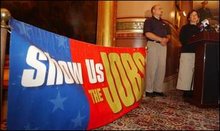
Jim & Those "12,000 New Jobs"
Sunday, December 23, 2007
Jobs: Rest of the Story
| Vermont Net Priv. Sector Job Growth: Nov. - Nov. | |
| 91 - 92 | 4,100 |
| 92 - 93 | 6,400 |
| 93 - 94 | 5,200 |
| 94 - 95 | 5,800 |
| 95 - 96 | 3,700 |
| 96 - 97 | 5,400 |
| 97 - 98 | 3,000 |
| 98 - 99 | 8,300 |
| 99 -00 | 3,700 |
| 00 - 01 | -600 |
| 01 - 02 | -3,800 |
| 02 - 03 | 1,600 |
| 03 - 04 | 3,100 |
| 04 - 05 | 1,400 |
| 05 - 06 | 1,200 |
| 06 - 07 | 900 |
And as you can see below, net private sector job growth in VT even lags behind the otherwise weak US recovery. In four of the last five years, VT annual private sector job growth has been less than 1%.
| Annual % Change in Priv. Sector Jobs: Nov. - Nov. | ||
| VT | US | |
| 91 - 92 | 2.0% | 0.8% |
| 92 - 93 | 3.1% | 2.7% |
| 93 - 94 | 2.4% | 3.9% |
| 94 - 95 | 2.6% | 2.3% |
| 95 - 96 | 1.6% | 2.7% |
| 96 - 97 | 2.3% | 3.0% |
| 97 - 98 | 1.3% | 2.6% |
| 98 - 99 | 3.5% | 2.6% |
| 99 - 00 | 1.5% | 1.7% |
| 00 - 01 | -0.2% | -1.8% |
| 01 - 02 | -1.5% | -0.7% |
| 02 - 03 | 0.6% | -0.1% |
| 03 - 04 | 1.2% | 1.7% |
| 04 - 05 | 0.6% | 2.1% |
| 05 - 06 | 0.5% | 1.8% |
| 06 - 07 | 0.4% | 1.1% |
What happened to Jim = Jobs?
Isn't it time to re-examine our policies?
Doug Hoffer
[all data is from the VT DoL, CES, seasonally adjusted]
Tuesday, December 18, 2007
A Downward Push: The Impact of Wal-Mart Stores on Retail Wages and Benefits
This study finds that Wal-Mart store openings lead to the replacement of better paying jobs with jobs that pay less and are less likely to provide health benefits. Wal-Mart's entry also drives wages and benefits down for workers in competing industry segments such as grocery stores.
Monday, December 17, 2007
Living Wage Policies and Wal-Mart
by Arindrajit Dube, Dave Graham-Squire, Ken Jacobs, and Stephanie Luce
In July 2006, the Chicago City Council passed a "Big Box Living Wage Ordinance," mandating that all retail stores larger than 90,000 square feet and operated by companies making more than $1 billion a year in revenue pay workers a minimum hourly wage of $10 per hour. The ordinance was vetoed by Mayor Richard Daley in September 2006, who said the measure would be harmful to the city.
The growth of big box retail is a mixed blessing to local communities. There is strong evidence that jobs created by Wal-Mart in metropolitan areas pay less and are less likely to offer benefits than those they replace.read more...
Friday, December 7, 2007
Home Heating Aid & Effiency
Its going to be a tough year for a lot of people.
The Bush administration is turning a blind eye to that reality. President Bush recently vetoed $2.4 billion in LIHEAP help for struggling families. President Bush wants to slash $379 million from the program that provides critical help to 5.8 million senior citizens on fixed-incomes and low-income families with children, including approximately 20,000 households in Vermont.
As this happens, there is great potential for tightening homes, and other thermal efficiency implementations. Remember last January's study with the unwieldy title “Vermont Energy Efficiency Potential Study for Oil, Propane, Kerosene and Wood Fuels Report” which spawned H 520? Succinctly, it found "the net present savings for the State of Vermont for long-term implementation of energy efficiency programs for oil, propane, kerosene and wood throughout the State over the next decade (2007-2016) is $486 million". Translation - that is $486 million in savings in Vermont after expenses. And $253 million of those net savings could be realized in the residential sector. That’s over $1,000 per Vermont household. According to the report, every dollar spent on thermal efficiency would save over $4.
Lets just find a way to make our houses warmer, while helping the planet too.
Thursday, December 6, 2007
Inadequate Mortgage Rate Freeze Plan
Statement by AFL-CIO President John Sweeney
on Bush Administration Mortgage Rate Freeze Plan
After sitting idly by for months while countless Americans saw their dreams slip away, the Bush Administration has put forth a plan to deal with the subprime mortgage crisis that is both too little and too late.
The plan to freeze rates that was outlined this afternoon would cover only a small fraction of the mortgages at risk. But this is not the time to pick and choose who deserves help and who doesn't. We need a moratorium on subprime mortgage foreclosures for at least six to 12 months - enough time to restructure the loans in question.
Guaranteed, that will dam the flood of Americans losing their homes and their life savings. That's the kind of bold leadership we need. Otherwise, the wave of foreclosures is going to crush our economy because banks will not actually restructure enough loans to head off a crisis. A foreclosure moratorium will give banks no choice.
Next, the mortgage industry and government must create a structured program providing for the replacement of teaser rate loans with conventional 30 year mortgages at the teaser rate.
Servicers must renounce those servicing agreements that reward mortgage companies for foreclosing on homes rather than encourage refinancing or other workout strategies. And servicers must commit to publicly reporting -- company by company -- how many subprime loans they are servicing, how many have reset, how many have been restructured and how many foreclosures are occurring and where.
Finally, the federal government must reach out to subprime borrowers to let them know how they can keep their homes. The Treasury Department has encouraged this type of outreach by private groups, but this effort should be much more extensive and should be led by the government.
These are the steps necessary to stabilize our housing markets, prevent cascading defaults and safeguard our economy. The subprime crisis is not just a subprime crisis, and it is not just a housing crisis or a financial crisis. It threatens to become a full-blown economic crisis affecting both growth and employment. The roots of this crisis lie in the lack of effective regulation of the mortgage and other financial markets and on our economic policy makers' reliance on asset inflation to power economic growth in recent years. Falling or stagnant real wages, extreme inequality and the dominance of financial gimmickry over good jobs that create real value have left tens of millions of Americans dependent on borrowing to sustain their standard of living. Enacting these reforms are the first, critical step toward creating an economy that works for all Americans.
Wednesday, November 28, 2007
The “F” Word
As Countrywide Financial Corp’s CEO was recently quoted, “Capitalism isn’t perfect.” Countrywide Credit is widely expected to file for bankruptcy.
Despite a lot of regulation in the banking industry, over 50% of mortgages are made by companies which are unregulated at the federal level. This reflects the fashionable bipartisan deregulation policies of the past 25 years.
If left to the market, resetting interest rates are going to push up defaults over the next eight months or so. This is true to a lesser extent in Vermont, where foreclosures through the first ten months of the year were 994, up 30% from a year ago, according to the Vermont Department of Banking, Insurance, Securities & Health Care Administration.
The state doesn’t have numbers on the number of mortgages which are due to reset in 2008-2009. One approach is to take the national average – about 35% of mortgages nationwide sold in 2005-2006 were adjustable rate mortgages – and apply that to the number of homes sold in 2005 and 2006. In 2005, 17,815 homes were sold, while last year 15,878 homes were sold, according to Vermont Realtors. That means that maybe there are maybe 11,800 or so adjustable rate mortgages in Vermont which will face increasing interest rates next year. Its not a huge number, but it could certainly spell trouble for the families and neighborhoods involved.
Foreclosure impacts everybody, the foreclosed family, renters and solvent homeowners, just in different ways. Foreclosed homes typically sell at a discount of 20-25% to other owner-occupied homes. This price drop drags down comparable prices in the neighborhood as the foreclosed home sales price is factored in. Renters can face eviction.
A few proposals being floated would limit the pain. The chair of the Federal Deposit Insurance Corp. is proposing that mortgage companies freeze interest rates on adjustable rate mortgages at the current rate to help borrowers avoid trouble. Essentially, this would convert the starter rate to a fixed rate. Banks will not be happy. Hey, if the “teaser” starter interest rate was good enough for the lending institution when it made the loan, it should be good enough for it for the life of the loan, no? A more tentative approach is being promoted by California Gov. Schwarzenegger who advocates freezing interest rates on certain adjustable rate mortgages for a period of time. Much more meaningful steps to protect homeowners and renters were taken during the New Deal, as in Canada today. What can and should Vermont policymakers do?